Introduction
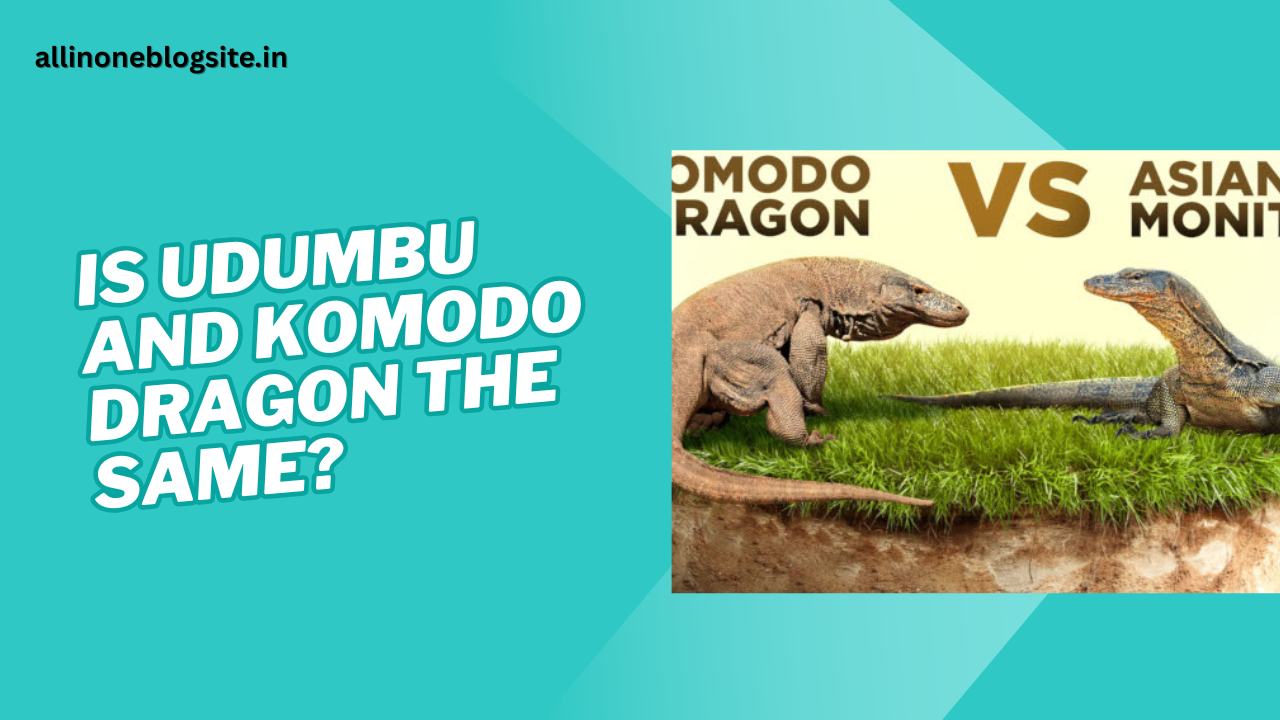
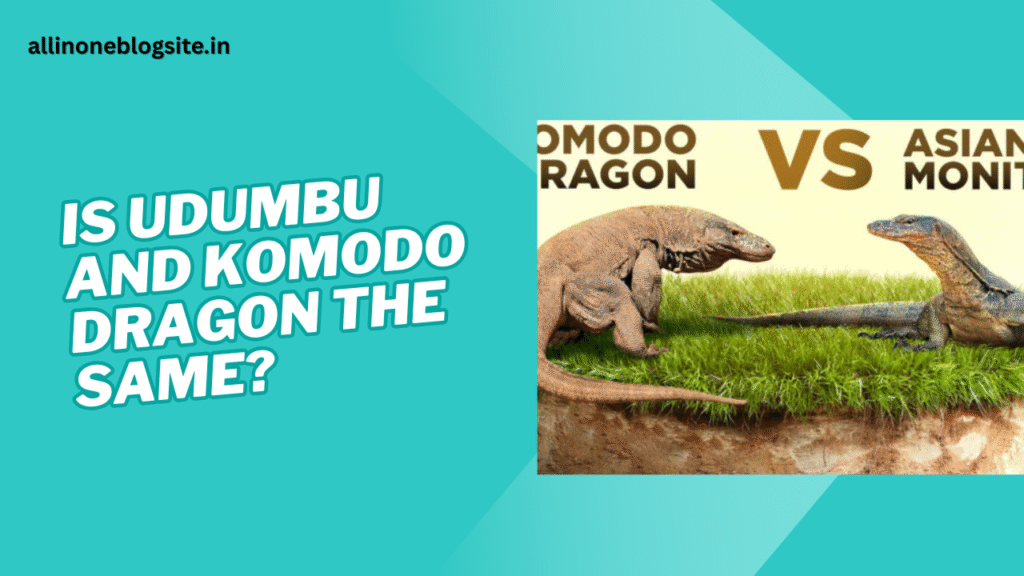
The Udumbu, frequently referred to as the Asian Water Monitor, and the Komodo Dragon are often a matter of inquiry for many people. At first glance, they are large, noteworthy reptiles that share some characteristics like powerful bodies, long tails, and forked tongues. The question arises, however, if they are of the same species or merely related as distant cousins? This question arises frequently as they are both family members under the monitor lizard group (Varanidae). However, this is where their likeness ends. Although also related, the Udumbu and Komodo Dragon vary in dimensions, habitats, nutrition, and even their venom. The paper presents a comprehensive view of the reptiles’ relations and differences by discussing their physical features, habitats, scientific classification, and behavior. We shall start now.
1. Understanding What “Udumbu” Means
1.1 What Is an Udumbu?
The word “Udumbu” refers to the Asian Water Monitor (Varanus salvator) in South Indian languages, especially Tamil and Malayalam. It is a member of a lizard family that includes the Komodo Dragon, with the latter being the only one that is bigger in size.
1.2 Basic Facts About Udumbu
- Scientific name: Varanus salvator
- Family: Varanidae
- Common name: Asian Water Monitor
- Habitat: Found in the Indian subcontinent and in Southeast Asia including Sri Lanka, Thailand, Malaysia and Indonesia.
- Diet: Carnivorous and opportunistic, feeding on fish, eggs, rodents, carrion, and occasionally small birds.
- Average length: 1.5 to 2.5 meters.
- Weight: 25–50 kilograms.
The Udumbu is a semi-aquatic animal that usually lives near water places like rivers, lakes, and swamps. It has good swimming and climbing abilities.
2. What Is a Komodo Dragon?
2.1 Basic Overview
The Komodo dragon (Varanus komodoensis) is a giant lizard among the living animals on planet Earth. Living in Indonesia, it has the potential to attain a length of 3 meters and an average of 70–90 kilograms in weight.
2.2 Key Facts
- Scientific name: Varanus komodoensis
- Family: Varanidae (the same family as the Udumbu)
- Habitat: Confined to a few Indonesian islands – Komodo, Rinca, Flores, Gili Motang, and Padar.
- Diet: Strictly carnivorous – hunts deer, pigs, and occasionally buffalo.
- Average life expectancy: Approximately 30 years in the wild.
- Unique feature: Has venom glands that can induce shock and inhibit clotting in the victim.
2.3 Komodo Dragon: The “King of Lizards”
The Komodo Dragon by its sheer size, powerful tail, and venomous bite has become the top predator in its habitat and has rightly been referred to as “King of Lizards”.
3. Scientific Relationship: Are They the Same Species?
3.1 Family and Genus
The Udumbu and Komodo Dragon share not only the same family, Varanidae, but also the same genus, Varanus. Thus, they are related but not the same species. Their classification is as follows:
| Classification | Udumbu (Asian Water Monitor) | Komodo Dragon |
|---|---|---|
| Kingdom | Animalia | Animalia |
| Phylum | Chordata | Chordata |
| Class | Reptilia | Reptilia |
| Order | Squamata | Squamata |
| Family | Varanidae | Varanidae |
| Genus | Varanus | Varanus |
| Species | V. salvator | V. komodoensis |
3.2 Genetic Connection
Their classification as different species is based on the fact that they show a significant amount of genetic divergence even though they still share a genus. The Komodo Dragon’s development in the middle of nowhere on islands resulted in its more colossal size — an instance of the phenomenon called island gigantism. The Udumbu, in contrast, evolved to be adaptable to marshy and forested regions, which, in turn, made it less demanding in terms of zonation and feeding.
4. Physical Differences
4.1 Size Comparison
- Komodo Dragon: Up to 3 m (10 ft) in length with a maximum weight of about 90 kg.
- Udumbu: Length between 1.5 and 2.5 meters and a weight of around 25 to 50 kg.
Thus, the Komodo Dragon is almost specifically a “giant” among lizards, being twice as heavy and longer than the Udumbu.
4.2 Skin and Color
- Udumbu: Skin that stays dark gray or brown with yellow designs. The skin is of a smoother and glossier type.
- Komodo Dragon: The more rugged, scaly skin comes with a grayish-brown coloration that provides the lizard with dry area’s camouflage.
4.3 Tail and Body Shape
Even though both of them have long tails, the tail of the Komodo Dragon is thicker and more muscular, the boss still using it as a powerful weapon in defense. The Udumbu’s tail is even more so, as it has become slightly flattened, which assists the animal in swimming.
4.4 Tongue
Like snakes, they both are using a forked tongue to smell air scent particles. With this, they can not only detect food but also identify the limits of their areas.
5. Habitat and Distribution
5.1 Udumbu Habitat
The Udumbu can be found throughout a large area that includes:
- India (mainly the southern states)
- Sri Lanka
- Bangladesh
- Thailand
- Malaysia
- Indonesia
Their favorite location is the tropics, not far from rivers and lakes, and they are often seen soaking on rocks or trees beside the water.
5.2 Komodo Dragon Habitat
Komodo Dragons are not found in any other place but Indonesian islands where they are called island specialists:
- Komodo
- Rinca
- Gili Motang
- Flores
- Padar
Their habitats are dry savannah, grasslands, and slopes of volcanoes. Due to their restricted distribution, they suffer more extinction threats than other animals.
5.3 Environmental Adaptations
| Feature | Udumbu | Komodo Dragon |
|---|---|---|
| Climate | Tropical & humid | Dry & arid |
| Water dependence | High | Low |
| Habitat range | Widespread | Restricted to few islands |
6. Diet and Hunting Style
The Udumbu diet and hunting style is opportunistic, and it can consume almost anything it can get its hands on:
- Fish and small amphibians
- Mollusks and crustaceans
- Birds and their offspring
- Animal fetuses
- Animal corpses
Sometimes they pick up food near dumps and riverbanks. On the contrary, The diet of the Komodo dragon is mainly of the predator type. It mostly feeds on large creatures such as:
- Deer
- Wild pigs
- Bison
- Komodo Dragons of the small size in rare cases
Hunting methods vary by animal:
- Udumbu harvest techniques: A combination of silence, swimming, and climbing. Either waiting time in carcasses or hunting of smaller animals is practiced actively.
- Komodo dragon predator style: Ambush is the main one – staying inactive and attacking with a quick bite. The venom works on the prey by tiring it through internal bleeding and shock.
Each of the two places has venom glands, but:
- The Udumbu’s venom is very mild and seldom causes any harm to a human.
- The venom of the Komodo Dragon is extremely powerful, and its purpose is to stop the blood from clotting which in turn leads to killing large prey.
7. Behavior and Temperament
7.1 Udumbu Behavior
- In general, they are timid and keep away from people.
- Very good swimmer and climber.
- When challenged only then they become aggressive.
- Frequently found sunbathing near water.
7.2 Komodo Dragon Behavior
- Very aggressive and has specific areas where they hunt.
- Active during the day.
- They can run fast for a short distance.
- Uses strong tail slaps and bites to defend itself.
- Dominant males sometimes fight during the breeding season.
8. Reproduction and Lifecycle
8.1 Udumbu
- Breeding season: It depends on the location, it is mostly during the warm months.
- Eggs: Up to 30 eggs are usually laid in a hole or at the base of a termite mound.
- Incubation: 6 to 8 months.
- Lifespan: 15 to 20 years usually.
8.2 Komodo Dragon
- Breeding season: The period of May to August.
- Eggs: each time about 20-30 eggs are produced.
- Incubation: around 8-9 months.
- Lifespan: up to 30 years in the wild.
Komodo Dragons also show parthenogenesis — the ability of females to produce offspring without mating.
9. Intelligence and Senses
Both reptiles exhibit considerable intelligence, superior to that of most other lizards.
9.1 Udumbu
- Can tell feeding times in captivity.
- Smell and tongue flicking are his means for food locating.
- Quickly adapts to the human environment.
9.2 Komodo Dragon
- Keeps in mind the limits of his domain.
- Takes note of the other ones in the area.
- Especially uniting in the hunting of large carcasses and coordinated hunting in the groups.
10. Interaction with Humans
10.1 Udumbu and Humans
The Udumbas are often sighted along the rivers or the edges of the farmlands in India and Sri Lanka. They look as if they could easily scare off any intruder but in fact, they are very man friendly and will only bite if disturbed. In some places, they are still regarded with fear and even hunted, although they are legally protected in many areas.
10.2 Komodo Dragon and Humans
Komodo Dragons have a reputation of being dangerous and fierce. Even though they are not a big threat to humans, there are still some attacks reported. Their bite is poisonous and very painful besides having the ability to inflict serious injury. Safety measures in place for the tourists on the Komodo Island include having trained rangers accompanying them at all times.
11. Conservation Status
11.1 Udumbu
- Status: Least Concern (IUCN)
- Threats: Destruction of the habitat, illegal hunting, and contamination are the main threats.
- Protection: Capture is prohibited by several national and regional laws.
11.2 Komodo Dragon
- Status: Endangered (IUCN)
- Threats: Climate change, rising sea levels, limited territory, human activities.
- Conservation measures:
- Creation of Komodo National Park was in 1980.
- Zoo breeding programs worldwide.
12. Key Differences at a Glance
| Feature | Udumbu (Asian Water Monitor) | Komodo Dragon |
|---|---|---|
| Size | 1.5–2.5 m, 25–50 kg | Up to 3 m, 90 kg |
| Habitat | Wetlands, forests | Dry islands |
| Behavior | Shy, adaptable | Aggressive, territorial |
| Venom | Mild | Potent |
| Distribution | Widespread in Asia | Only in Indonesia |
| Conservation Status | Least Concern | Endangered |
| Human Danger | Low | High |
13. Myth vs. Reality
- Myth 1: Udumbu and Komodo Dragon are indistinguishable.
- Reality: They are of the same family but different genera.
- Myth 2: Komodos are dinosaurs.
- Reality: They are old but not prehistoric reptiles. They adapted long after the extinction of dinosaurs.
- Myth 3: Udumbu can kill a man.
- Reality: Unlikely. These snakes are non-aggressive. Their poison is weak.
14. Ecological Importance
The two reptiles are indispensable in the ecosystems:
- They keep down the number of rodents and other small animals.
- They take part in the process of decomposition by feeding on carcasses.
- They contribute to the replenishing of the soils in the food chains by their excreta.
In simple terms, they are the cleaner and the controllers of the predators in nature.
15. Which Is Stronger: Udumbu or Komodo Dragon?
The Komodo Dragon would probably come out victorious if the two were to fight, because of the following:
- Heavier weight
- More powerful bite
- More venomous
At the same time, the agility and the ability of the Udumbu to swim grant it an edge in the areas full of water.
16. Why People Confuse Them
People easily associate one of them with the other because:
- Both are of similar appearance and have forked tongues.
- Species of the same genus (Varanus).
- Are found in places adjacent to each other (Indonesia, India, etc.).
However, if one digs deeper through size, habitat, and behavior one will find the differences quite significant.
17. The Cultural Connection
The Udumbu is that popular in India to be regarded as a cultural and traditional character in some places. In turn, the Komodo Dragon has become a symbol of Indonesia and a major drawn for tourists. Both of them are the reptiles whom the people of the respective countries respect and they are often associated with such attributes as power and perseverance.
18. Final Verdict
In conclusion, can we consider the Udumbu as the Komodo Dragon? Not really. They share a common ancestor but are not the same. The Udumbu (Varanus salvator) is a more diminutive, partly aquatic crocodile-like lizard inhabiting Asia mainly. The Komodo Dragon (Varanus komodoensis) is a huge, poisonous beast that can only be found on a number of islands in Indonesia. They are both wondrous beings — indeed, they are the ones that lived through the ages — and their adaptations to the surroundings are remarkable.
Also Read: Are Iguanas Carnivores, Herbivores, or Omnivores?.